Difference between revisions of "Heath"
| (17 intermediate revisions by 4 users not shown) | |||
| Line 1: | Line 1: | ||
| − | { | + | {{Infobox location |
| − | | | + | | name = Heath |
| − | + | ||
| − | + | ||
| − | + | ||
| − | + | ||
| − | + | ||
| − | + | ||
| − | + | ||
| − | + | ||
| − | + | ||
| − | + | ||
| − | + | ||
| − | + | ||
| − | + | ||
| − | + | ||
| − | + | ||
| − | + | ||
| − | + | ||
| − | + | ||
| − | + | ||
| − | + | ||
| − | + | ||
| − | + | ||
| − | + | ||
| − | + | ||
| − | + | ||
| − | + | ||
| + | | image1 = http://brokendagger.com/wiki/images/map/wiki_regions_heath.jpg | ||
| + | | alt1 = | ||
| + | | caption1 = | ||
| + | | image2 = http://brokendagger.com/wiki/images/map/wiki_map_heath.png | ||
| + | | alt2 = | ||
| + | | caption2 = <small>[[Heath]]'s location (dark green) within the [[Amasynian Peninsula]] (light green), relative to [[Regal Province]] of [[Trae Kelsa]] (blue).</small> | ||
| + | | type = Territory | ||
| + | | description = Bickering fiefdoms | ||
| + | | region = [[Trae Kelsa]] | ||
| + | | subregion = [[Amasynian Province]] | ||
| + | | population = 150,000 | ||
| + | | area = 1500 | ||
| + | | capital = [[Threminor]] | ||
| + | | demonym = Heathian | ||
| + | | government = Feudal Monarchy | ||
| + | | ruler = Duke | ||
| + | | currency = Trae Kelsan Shilling | ||
| + | | religion = [[Old Ways]]<br>[[One True Faith]] | ||
| + | }} | ||
| − | + | [[Heath]], officially the '''Duchy of Heath''', is a region in the south of the [[Amasynian Peninsula]]. It is bordered to the north by [[Amasynia]], [[Myrken Wood]] and [[Derry]], to the east by [[Thessilane]] and to the west by [[Xanth Grange]]. | |
| − | |||
| − | + | ==History== | |
| − | == | + | ===The Days of Life=== |
| − | + | For most of their history, the ''Frum-Bearn'' ("First Born") lived in clans that warred, adventured, and occasionally sued for peace. These were known as the ''Ealdordagas'' ("Days of Life"), a time of great heroes and demigods who walked the earth doing great, if sometimes terrible, things. It was a mythic time nearly lost to the shrouded mist of the past and yet kept fiercely alive in the old stories and songs. Some of the great deeds included in these lost times include the brief capture of Winter, the Splintering of the Sun, and the War of Two-As-One. It was said that many warriors kept the heads of their fallen enemies, ran naked into battle, and hurled these morbid projectiles into the enemy ranks. Such enduring tales have given rise to the understanding of Heathite savagery. | |
| − | + | ||
| − | + | ||
| − | + | ||
| − | == | + | |
| − | + | ||
| − | + | ||
| − | + | ||
| − | + | ||
| − | == | + | |
| − | + | ||
| − | + | ||
| − | + | ||
| − | + | ||
| − | + | ||
| − | + | ||
| − | For most of their history, the Frum-Bearn ( | + | |
| − | The next significant chapter in Frum-Bearn history is known as The Burning Times. | + | ===The Burning Times=== |
| + | The next significant chapter in Frum-Bearn history is known as The Burning Times. ''[[Losiar Gan]]'' (the Lost Walker) wandered the countryside, stealing away the souls of all whose bodies lay beneath the ground while those souls prepared themselves for reincarnation. During these turbulent times many people took it upon themselves to guard the barrows and graves of their relatives, giving rise to the ''Hyrdraeden'' ("guardianship") that were not necessarily skilled at arms but were people of great spiritual fortitude and keen intellect. | ||
| − | However, Great Alaric Mourne bested Losiar Gan by flattering him into a memorization game although the victory released the souls into Mourne and caused him to walk a year and a day for every soul he had won. | + | However, Great [[Alaric Mourne]] bested [[Losiar Gan]] by flattering him into a memorization game although the victory released the souls into Mourne and caused him to walk a year and a day for every soul he had won. It is said he still stalks the night, bested by his own cleverness and desire for power. The Hyrdraeden became quickly obsolete though the tradition of wise men, ready to defend their people, is a point of pride amongst the First Born to this day. |
| − | With | + | With [[Alaric Mourne|Mourne]]’s vanishing people were free to bury their dead once more though occasionally people will opt not to if they fear for their reincarnation. In such instances someone very trusted will be asked to stand as Hyrdraeden as the body burns. To be asked to serve as such is considered a great honor. |
| − | For several centuries following Mourne’s disappearance into the world, though the inter-clan rivalries continued, the time of great wonders and mythic tales seemed to fade into nothing but memory. | + | For several centuries following Mourne’s disappearance into the world, though the inter-clan rivalries continued, the time of great wonders and mythic tales seemed to fade into nothing but memory. Some speculated that Alaric Mourne had taken away the bravest and greatest spirits with his departure which left the First Born ripe to rot and in time be conquered. |
| − | + | ||
| − | + | ||
| + | ===The Amasynian Period=== | ||
| + | At first it was the people of [[Kingdom of Amasynia|Amasynia]] who grew bold. Too bold, some had said, yet the internecine struggles left them powerless. Great heroism had gone, leaving behind petty rivalry and jealousy that led chieftains to side with Amasynians against their fellow First Born. Outrage grew only as the war became a steady defeat despite several valiant offensives. The conquest of Heath in 1296 [[Anno Inceptum|A.I.]] brought with it the promise of economic significance as the region rose to prominence in the following centuries as an important trading crossroads for the [[Amasynian Peninsula]]. | ||
| − | + | In turn, [[Amasynia]], and with it Heath, was conquered by [[Trae Kelsa]] in 1527 [[Anno Inceptum|A.I.]]. As trade increased in goods, so it did in ideas. Missionaries came preaching the [[One True Faith]] and stories and identity were often dismissed as folklore or mere savagery. However, for every person who heralded their incorporation into the kingdom as a move into the light of civilization, another missed the Old Ways and clung to them with greater ferocity. | |
| − | |||
| − | + | ==Government== | |
| + | Heath's government might best be described as "fractured". In principle the region is ruled under a feudal system, the lords and barons serving as vassals to the Duke of Heath, in turn being granted the right to rule their individual fiefs as they see fit. In practice, Heath is more often than not plagued by internal strife and conflict as the barons, lords and nobles each seek to expand their own holdings at the expense of their neighbours, by force of arms as often as by political maneuverings. | ||
| − | + | ===Politics=== | |
| + | |||
| + | ===Law and Order=== | ||
| + | The petty lords of Heath's scattered feudal estates are charged with keeping the peace on and around their own lands, and most maintain a corps of reeves who organise defence against the bands of reavers and raiders who infest the rugged terrain of the borderlands. The Duke's soldiers also mount regular patrols, predominantly to protect merchant caravans from attack by bandits and robbers in the northern moors and forests. | ||
| − | + | ===Military=== | |
| + | As feudal liege of Heath, the Duke has the authority to call upon each of his lords to supply a body of soldiers in times of war; in addition to this, the Duke maintains a modest standing army of his own soldiers, which is as often employed to maintain order among his own barons as it is to defend Heath from external aggressors. | ||
| − | == | + | ==Geography== |
| + | From the coast of [[Thremin Bay]] in the south, the land rises gradually into rolling, fertile hills to high moorland abutting the [[Fraoch Mountains]] to the east, and the thick [[Peallach Forest]] that lines the [[Sagpa River]] valley to the north-east, forming Heath's border with [[Myrken Wood]], [[Derry]] and [[Thessilane]]. To the west the broad [[Nathair River]] separates the land from [[Xanth Grange]]. | ||
| − | + | ===Cities=== | |
| + | The capital city of [[Threminor]] is easily the duchy’s oldest continuously-inhabited settlement, a winding maze of old roads that has stood at the northernmost point of [[Thremin Bay]] since the Burning Times; the city has been repeatedly built upon itself in the wake of natural disasters and military invasions. Following the Trae Kelsan conquest of the [[Kingdom of Amasynia]] the Crown felt it wise to construct a stout wall and appropriate fortifications in order to protect this important trading hub from assault by land or sea. | ||
| + | ===Travel=== | ||
| + | Heath serves as a central hub for trade goods throughout the [[Amasynian Province]]. The capital city of [[Threminor]] is readily accessible by sea, and the [[Sagpa River]] provides a route into the very heart of the Amasynian Peninsula. An extensive road network over the hills and moorlands connects the townships and cities of Heath, and broad highways span the land such that from Heath one might readily travel between any of its half-dozen neighbouring regions. | ||
| − | == | + | ===Climate=== |
| + | Strong winds from the mountains meet occasional ocean breezes resulting in frequent storms and a fair amount of thunder storms and precipitation. Due to the warmer ocean breeze during winter, however, there is rarely much snow accumulation for the eastern half of the territory. | ||
| − | |||
| + | ==Economy== | ||
| + | While Heath is largely self-sufficient due to its fertile land, ample forests, and mineral-rich mountains which provide for most of the needs of its citizens, trade is the region's lifeblood. Heath's domestic output is unremarkable among its neighbours on the Amasynian Peninsula, but the region possesses substantial shipyards and bustling ports that thrive on seafaring commerce, and the land's rulers reap a rich profit from trade tariffs on goods passing through Heath on the way to the northern regions of the [[Amasynian Peninsula]]. | ||
| + | |||
| + | While still upholding a feudal system, the wealth and standing of native merchants is often enough to challenge these lordly figures. The countryside may be home to the landholders but the capital is home to the merchants and their guilds. | ||
| − | |||
| − | + | ==Culture== | |
| + | Heath is a culture in conflict with itself. There are many ancient traditions that are still with the populace that have been influenced by outside traditions. The solstices and equinoxes remain observed by those who follow the Old Ways, and even adherents of the [[One True Faith]] may celebrate these dates though without the religious meaning. Heath is an old land, dotted with barrows and burial mounds of past lords and heroes, the fire-blackened tops of the Pyre Hills used during the Burning Times for the mass cremation of the dead, and the significance of remembering things as the Old Teachings were never written down. Losing one's memory is considered a serious and sorrowful event, whether it be through amnesia or encroaching senility. Oaks are considered sacred by many given their significance to the Druidic Tradition (mentioned below) even by converts to the [[One True Faith]] who desire to follow their one deity while at the same time remaining in good standing with the ancient nature spirits who are still believed to haunt the land. | ||
| + | Missionaries brought with them the [[One True Faith]] whose adherents are most concentrated in the capital city of [[Threminor]], but who can be found throughout the countryside. The belief often teeters on the brink of outright syncretism as new believers often still feel compelled to leave a small offering for fertile crops to the old deities despite their supposedly new allegiance. | ||
| − | |||
| − | + | ==Religion== | |
| − | + | The Old Ways consist of a pantheon of deities with their own portfolios and concerns and an adherent of the old faith might pray to any deity at any given time, depending upon what one wanted. The priests of this particular religion are called druids who still meet amongst the ancient oak groves of Heath and whose knowledge of history, astrology and the natural world is recognized far and wide. This tradition is known as the Druidic Tradition. | |
| − | The | + | |
| − | + | ||
| − | + | ||
| − | + | ||
| − | + | ||
| − | + | ||
| − | + | ||
| − | + | ||
| − | + | ||
| − | + | ||
| + | There is also a smaller group of the First Born of Heath who worship a small pantheon of deities, each of which stands as the embodiment and custodian of a given season. The passing of the seasons during the equinoxes and solstices is particularly important to this tradition, known as the Ancient Circle. | ||
[[Category:Geography]] | [[Category:Geography]] | ||
| − | [[Category: | + | [[Category:Regions]] |
| + | [[Category:Amasynian Province]] | ||
[[Category:Heath]] | [[Category:Heath]] | ||
Latest revision as of 16:03, 29 April 2014
| Heath | |
|---|---|
 | |
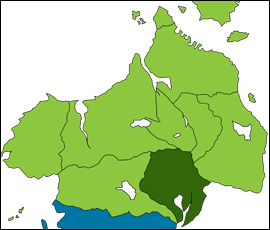 Heath's location (dark green) within the Amasynian Peninsula (light green), relative to Regal Province of Trae Kelsa (blue). | |
| Information | |
| Type | Territory |
| Description | Bickering fiefdoms |
| Region | Trae Kelsa |
| Subregion | Amasynian Province |
| Population | 150,000 |
| Area | 1500 |
| Capital | Threminor |
| Demonym | Heathian |
| Government | Feudal Monarchy |
| Ruler | Duke |
| Currency | Trae Kelsan Shilling |
| Religion | Old Ways One True Faith |
Heath, officially the Duchy of Heath, is a region in the south of the Amasynian Peninsula. It is bordered to the north by Amasynia, Myrken Wood and Derry, to the east by Thessilane and to the west by Xanth Grange.
Contents
History
The Days of Life
For most of their history, the Frum-Bearn ("First Born") lived in clans that warred, adventured, and occasionally sued for peace. These were known as the Ealdordagas ("Days of Life"), a time of great heroes and demigods who walked the earth doing great, if sometimes terrible, things. It was a mythic time nearly lost to the shrouded mist of the past and yet kept fiercely alive in the old stories and songs. Some of the great deeds included in these lost times include the brief capture of Winter, the Splintering of the Sun, and the War of Two-As-One. It was said that many warriors kept the heads of their fallen enemies, ran naked into battle, and hurled these morbid projectiles into the enemy ranks. Such enduring tales have given rise to the understanding of Heathite savagery.
The Burning Times
The next significant chapter in Frum-Bearn history is known as The Burning Times. Losiar Gan (the Lost Walker) wandered the countryside, stealing away the souls of all whose bodies lay beneath the ground while those souls prepared themselves for reincarnation. During these turbulent times many people took it upon themselves to guard the barrows and graves of their relatives, giving rise to the Hyrdraeden ("guardianship") that were not necessarily skilled at arms but were people of great spiritual fortitude and keen intellect.
However, Great Alaric Mourne bested Losiar Gan by flattering him into a memorization game although the victory released the souls into Mourne and caused him to walk a year and a day for every soul he had won. It is said he still stalks the night, bested by his own cleverness and desire for power. The Hyrdraeden became quickly obsolete though the tradition of wise men, ready to defend their people, is a point of pride amongst the First Born to this day.
With Mourne’s vanishing people were free to bury their dead once more though occasionally people will opt not to if they fear for their reincarnation. In such instances someone very trusted will be asked to stand as Hyrdraeden as the body burns. To be asked to serve as such is considered a great honor.
For several centuries following Mourne’s disappearance into the world, though the inter-clan rivalries continued, the time of great wonders and mythic tales seemed to fade into nothing but memory. Some speculated that Alaric Mourne had taken away the bravest and greatest spirits with his departure which left the First Born ripe to rot and in time be conquered.
The Amasynian Period
At first it was the people of Amasynia who grew bold. Too bold, some had said, yet the internecine struggles left them powerless. Great heroism had gone, leaving behind petty rivalry and jealousy that led chieftains to side with Amasynians against their fellow First Born. Outrage grew only as the war became a steady defeat despite several valiant offensives. The conquest of Heath in 1296 A.I. brought with it the promise of economic significance as the region rose to prominence in the following centuries as an important trading crossroads for the Amasynian Peninsula.
In turn, Amasynia, and with it Heath, was conquered by Trae Kelsa in 1527 A.I.. As trade increased in goods, so it did in ideas. Missionaries came preaching the One True Faith and stories and identity were often dismissed as folklore or mere savagery. However, for every person who heralded their incorporation into the kingdom as a move into the light of civilization, another missed the Old Ways and clung to them with greater ferocity.
Government
Heath's government might best be described as "fractured". In principle the region is ruled under a feudal system, the lords and barons serving as vassals to the Duke of Heath, in turn being granted the right to rule their individual fiefs as they see fit. In practice, Heath is more often than not plagued by internal strife and conflict as the barons, lords and nobles each seek to expand their own holdings at the expense of their neighbours, by force of arms as often as by political maneuverings.
Politics
Law and Order
The petty lords of Heath's scattered feudal estates are charged with keeping the peace on and around their own lands, and most maintain a corps of reeves who organise defence against the bands of reavers and raiders who infest the rugged terrain of the borderlands. The Duke's soldiers also mount regular patrols, predominantly to protect merchant caravans from attack by bandits and robbers in the northern moors and forests.
Military
As feudal liege of Heath, the Duke has the authority to call upon each of his lords to supply a body of soldiers in times of war; in addition to this, the Duke maintains a modest standing army of his own soldiers, which is as often employed to maintain order among his own barons as it is to defend Heath from external aggressors.
Geography
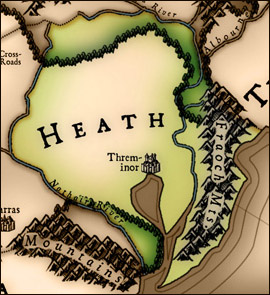
From the coast of Thremin Bay in the south, the land rises gradually into rolling, fertile hills to high moorland abutting the Fraoch Mountains to the east, and the thick Peallach Forest that lines the Sagpa River valley to the north-east, forming Heath's border with Myrken Wood, Derry and Thessilane. To the west the broad Nathair River separates the land from Xanth Grange.
Cities
The capital city of Threminor is easily the duchy’s oldest continuously-inhabited settlement, a winding maze of old roads that has stood at the northernmost point of Thremin Bay since the Burning Times; the city has been repeatedly built upon itself in the wake of natural disasters and military invasions. Following the Trae Kelsan conquest of the Kingdom of Amasynia the Crown felt it wise to construct a stout wall and appropriate fortifications in order to protect this important trading hub from assault by land or sea.
Travel
Heath serves as a central hub for trade goods throughout the Amasynian Province. The capital city of Threminor is readily accessible by sea, and the Sagpa River provides a route into the very heart of the Amasynian Peninsula. An extensive road network over the hills and moorlands connects the townships and cities of Heath, and broad highways span the land such that from Heath one might readily travel between any of its half-dozen neighbouring regions.
Climate
Strong winds from the mountains meet occasional ocean breezes resulting in frequent storms and a fair amount of thunder storms and precipitation. Due to the warmer ocean breeze during winter, however, there is rarely much snow accumulation for the eastern half of the territory.
Economy
While Heath is largely self-sufficient due to its fertile land, ample forests, and mineral-rich mountains which provide for most of the needs of its citizens, trade is the region's lifeblood. Heath's domestic output is unremarkable among its neighbours on the Amasynian Peninsula, but the region possesses substantial shipyards and bustling ports that thrive on seafaring commerce, and the land's rulers reap a rich profit from trade tariffs on goods passing through Heath on the way to the northern regions of the Amasynian Peninsula.
While still upholding a feudal system, the wealth and standing of native merchants is often enough to challenge these lordly figures. The countryside may be home to the landholders but the capital is home to the merchants and their guilds.
Culture
Heath is a culture in conflict with itself. There are many ancient traditions that are still with the populace that have been influenced by outside traditions. The solstices and equinoxes remain observed by those who follow the Old Ways, and even adherents of the One True Faith may celebrate these dates though without the religious meaning. Heath is an old land, dotted with barrows and burial mounds of past lords and heroes, the fire-blackened tops of the Pyre Hills used during the Burning Times for the mass cremation of the dead, and the significance of remembering things as the Old Teachings were never written down. Losing one's memory is considered a serious and sorrowful event, whether it be through amnesia or encroaching senility. Oaks are considered sacred by many given their significance to the Druidic Tradition (mentioned below) even by converts to the One True Faith who desire to follow their one deity while at the same time remaining in good standing with the ancient nature spirits who are still believed to haunt the land.
Missionaries brought with them the One True Faith whose adherents are most concentrated in the capital city of Threminor, but who can be found throughout the countryside. The belief often teeters on the brink of outright syncretism as new believers often still feel compelled to leave a small offering for fertile crops to the old deities despite their supposedly new allegiance.
Religion
The Old Ways consist of a pantheon of deities with their own portfolios and concerns and an adherent of the old faith might pray to any deity at any given time, depending upon what one wanted. The priests of this particular religion are called druids who still meet amongst the ancient oak groves of Heath and whose knowledge of history, astrology and the natural world is recognized far and wide. This tradition is known as the Druidic Tradition.
There is also a smaller group of the First Born of Heath who worship a small pantheon of deities, each of which stands as the embodiment and custodian of a given season. The passing of the seasons during the equinoxes and solstices is particularly important to this tradition, known as the Ancient Circle.
